
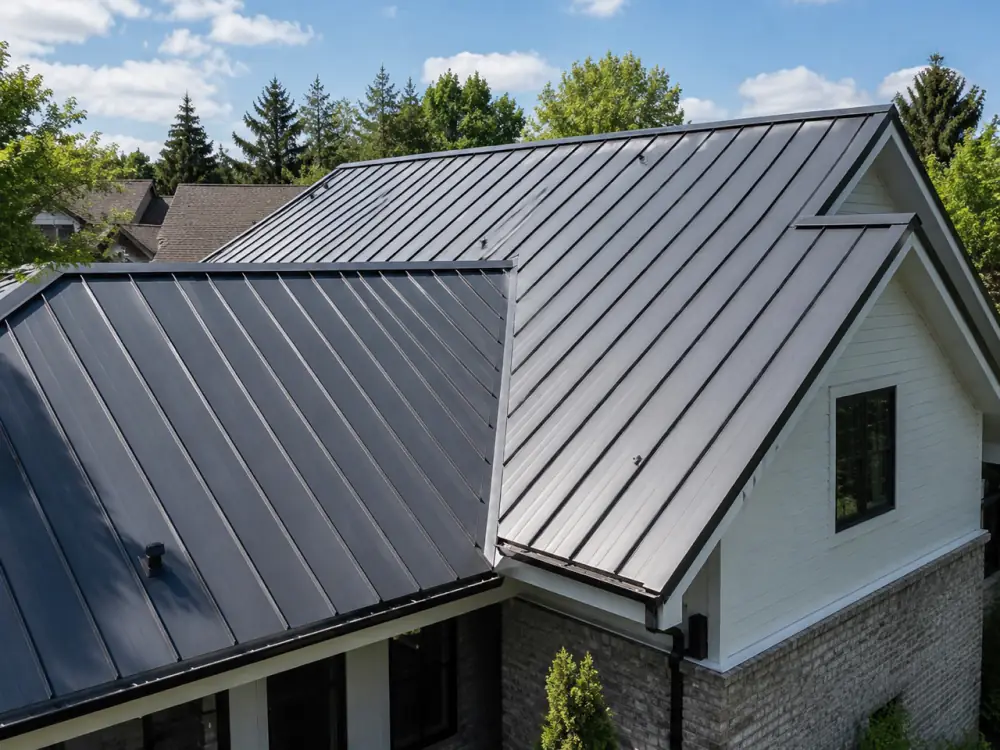
For a Saskatchewan roof, the two materials most homeowners weigh are asphalt shingles and metal. Both work here, but they behave very differently through a prairie winter, and the right answer depends on how long you plan to stay and what you want the roof to do.
We are W Contracting Roofing, a Saskatoon roofing company, and we install both of the systems compared below.
Here is how metal roofing and asphalt shingles compare on the things that actually matter on the prairies: snow, ice, hail, lifespan and cost.
| What matters | Metal | Asphalt shingles |
|---|---|---|
| Snow and ice | Sheds snow before it can build into a heavy load | Holds snow longer, so attic ventilation and clear eavestroughs matter more |
| Hail | Resists punctures, though a bad storm can leave cosmetic dents | Absorbs a hard hit without denting, but a severe storm can bruise it and strip the granules |
| Lifespan | Forty to sixty years or more | Twenty to thirty years in this climate |
| Cost | Costs more up front | Less up front, the main reason many homeowners still choose it |
How each one handles snow and ice
Metal is hard to beat at shedding snow, because its smooth surface lets snow slide off before it can build into a heavy load and gives ice dams less to form on.
Asphalt shingles hold snow longer, so attic ventilation and clear eavestroughs, soffit and fascia matter more to keep ice dams in check. Both can be detailed to handle a prairie winter well, but metal has the edge on snow shedding, and a properly vented shingle roof closes most of the gap.
Standing up to prairie hail
Saskatoon gets serious hail, and it is the one area where the two trade places. Metal resists punctures and rarely loses its waterproofing to hail, though a bad storm can leave cosmetic dents. Asphalt shingles absorb a hard hit without denting, but a severe storm can bruise them and strip the granules that protect them, and that bruising is what our HAAG Certified inspection checks for.
Impact-rated shingles narrow that difference. Either way, storm damage is often an insurance matter, which our hail damage insurance claim guide explains.
How long each roof lasts
This is the clearest difference between them. A quality metal roof can last forty to sixty years or more, often outliving the owner's time in the house.
Asphalt shingles in this climate generally last twenty to thirty years, with the prairie sun and freeze-thaw pushing toward the shorter end. If you plan to stay in the home for decades, metal can be the last roof you buy.
What each one costs
Metal costs more up front. The material and the skilled labour to install it correctly are a larger investment than a shingle roof, and that is the main reason many homeowners still choose asphalt. Over the long run the math can even out, because a metal roof may never need replacing while the prairie sun and freeze-thaw eventually wear out a shingle roof.
There is no single right answer here, only what fits your budget and how long you will own the home. We keep financing available through Financeit for either option, and we never put a number on a roof without seeing it first.
Noise, appearance and energy
The old idea that a metal roof is loud in the rain does not hold with a modern install over solid decking and underlayment, where it sounds close to a shingle roof. Metal comes in standing-seam and metal-shingle profiles and a wide colour range, while asphalt offers the familiar dimensional look and the GAF shingle colours most prairie homes wear. Light-coloured metal can also reflect summer heat, which helps through the few very hot weeks.
Weight, warranty and installation
Both materials sit comfortably on a standard Saskatchewan home. Metal is lighter than it looks, so it rarely needs extra framing, and it is often installed over solid decking and underlayment. It does take more skill and time to flash and fasten correctly, which is part of the up-front cost, while asphalt goes down faster and that keeps it the common choice.
Warranties differ as well: metal panels often carry long manufacturer coverage on the finish, and a quality asphalt system like the GAF shingles we install comes with its own manufacturer warranty. Either roof is backed by our ten-year workmanship warranty on the install itself.
Older homes and newer ones
The age of the house changes this decision more than most people expect. Saskatoon has early-1900s homes with steep pitches and dormers, 1960s to 80s bungalows and large new subdivisions, and each one takes a new roof a little differently.
Acreages, shops and detached garages
We quote acreage and farm roofs around Saskatoon, and out there metal makes a lot of sense on shops and detached garages. Those are usually big, simple roof shapes, which suit metal well.
You do not have to use one material for the whole yard. Metal on the shop with GAF shingles on the house is a reasonable split, and you can ask for each building to be quoted separately so you see what each choice costs.
Open land is also harder on a roof in wind. With no trees or neighbours to break it, the fastening and the edges take the most stress on either material, so our crew takes its time on them.
What each roof goes through in a Saskatoon year
Photos to keep for insurance
Take photos of the new roof once it is finished and keep them with your policy papers. If hail or wind hits later, those pictures give your adjuster a clear before to compare against.
- Each side of the roof, shot from the yard or the street.
- Close shots of the vents and pipe flashing.
- Eavestroughs and downspouts, since dents on them are an easy sign to show your SGI or private adjuster after hail.
- On a metal roof, a few shots at a low angle along the panels, since small dents show up best when the light hits them from the side.
- The date, either on the photo or in a note saved with it.
We document our own work with photos and video during the job, and those are worth saving in the same folder. Ask your insurer how your policy treats dents on metal that do not cause a leak, since the answer can tip the choice. If you ever do file, our roof insurance claims page explains how we work with your SGI or private adjuster.
Questions to ask before you choose
Bring these to any estimate, ours included. A roofer who installs both materials should be able to answer each one plainly.
- Can I get a written quote for both metal and shingles on this roof?
- What happens if you find rotten boards under the old roof?
- How will you flash around the chimney and any skylights?
- Where will snow come off this roof, and is anything underneath it?
- What does the manufacturer warranty cover, and what does your workmanship warranty cover? Ours is ten years on the install, through GAF.
- Can I spread the cost? We offer financing through Financeit on either roof.
Which is right for your home
If you want the longest-lasting roof and the best snow shedding, and you plan to stay put, metal is worth the higher up-front cost. If you want a proven, lower-cost roof that any crew can service and that suits most Saskatoon homes, quality asphalt shingles installed properly are hard to fault.
The honest answer usually comes down to budget and how long you will be in the house. Our metal roofing and roof replacement pages cover each option, and a free inspection is the fastest way to get a recommendation for your specific roof.
How we compare them at your free inspection
- We get on the roof and document what we find with photos and video.
- We check the deck and the flashing, since those two decide a lot about how long either roof lasts through Saskatchewan winters.
- You get a written quote for each option with the scope spelled out, so you can compare them line by line.
- If shingles are in the running, we bring GAF colour samples so you can see them against your siding in daylight.
- When the job is done we run a final quality-control check and hand you the 10-year workmanship warranty.
We do it the same way on a house in the city as on a roof out near Martensville or Warman.