
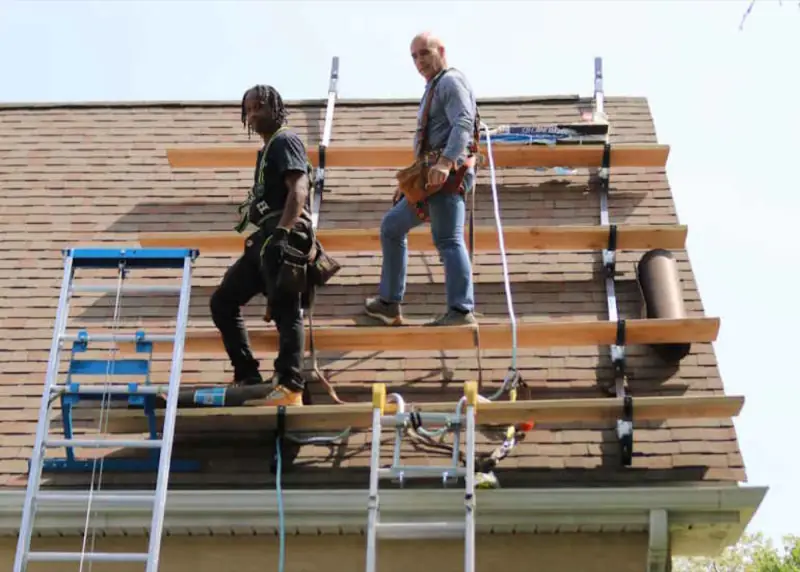
On the prairies, the roof does its hardest work in the months you are least likely to be looking at it. A little attention in the fall, while the weather still lets you, is what keeps a small problem from turning into a winter leak.
We are W Contracting Roofing, a Saskatoon roofing company, and freeze-up is what the prep below is aimed at.
None of this takes long, and most of it you can do from the ground or the attic. Here is the short list we would run through on our own homes before the snow settles in for the season.
1. Clear the eavestroughs and downspouts
Leaves and grit left in the eavestroughs over winter give meltwater nowhere to drain, so it sits at the edge of the roof and freezes. That frozen edge is where ice dams start.
Clear the troughs and make sure the downspouts run water at least 2 m (6 ft) from the foundation before the first hard freeze. If the eavestroughs, soffit and fascia are sagging or pulling loose, they will not do their job no matter how clean they are, and that is worth fixing now.
Where the downspouts should drain
The City of Saskatoon sets out where roof downspouts should empty in its lot grading requirements. In short, a downspout should:
- reach at least 2 m (6 ft) out from the foundation
- point to the front or back yard, not the side yard
- stop at least 3 m (10 ft) short of the front or rear property line
- let out onto lawn or garden, never onto a neighbour's yard, a sidewalk, the street or the back lane
Extensions get knocked loose by mowers and snow shovels, so check they are still on before the snow hides them. The spring melt will run out through the same spot.
2. Look over the shingles from the ground
Walk the yard and look up. Missing, cracked or curling shingles leave the layer underneath open to wind-driven snow, and one lifted shingle in September is an easy fix compared to what the same gap lets in by March.
Piles of the sand-like granules at the bottom of a downspout are another sign the shingles are wearing thin. Our guide to the signs a roof needs repair before winter covers what to look for in more detail.
3. Check the flashing around chimneys and vents
Most leaks do not start out in the open field of shingles. They start where two surfaces meet: the flashing around a chimney, a vent stack or a skylight. Flashing that has cracked, lifted or lost its sealant is a common winter leak point, and caught in September or October it is usually a small roof repair rather than a big one.
From the ground, look for flashing that has pulled away from the chimney brick, or dark streaks on the shingles just below a vent. Inside, a ceiling stain close to a chimney or a bathroom fan is worth tracing to the flashing first.
4. Get into the attic
The attic tells you as much about a winter roof as the shingles do. On a bright day, a pinhole of daylight means a matching hole in the roof. Damp insulation or frost on the underside of the sheathing points to warm air escaping from the house, the same heat loss that melts the bottom layer of snow through December and January and builds ice dams.
If the insulation is thin or the venting looks blocked, that is worth sorting before the cold sets in. There is more on how that chain works in our guide to preventing ice dams.
5. Trim branches back from the roof
Branches that hang over or brush against the roof drop debris into the valleys, scuff the shingles in the wind, and load the roof with extra snow when they bend under it. A hard prairie storm can bring a limb down entirely. Cutting them back before winter is cheap insurance for the roof and the eavestroughs both.
Do the cutting from the ground where you can, and leave any branch near a power line to a tree service. If you can see leaves piled in a valley, the channel where two roof slopes meet, get them out before the October frosts freeze them in place.
6. Deal with any hail or storm damage now
If a summer storm came through, do not let the damage ride into winter. Bruised or bald shingles from hail hold up far worse once a Saskatoon winter sets in, and the first cold snap can turn a minor bruise into an open leak. If you are not sure whether a storm did anything, our guide on what to do after a hail storm and the storm and hail damage restoration page walk through the next steps and how a claim fits in.
Before anything gets fixed, take clear photos of the damage you can see from the ground and write down the date of the storm. Our page on roof insurance claims in Saskatoon explains how our HAAG Certified inspection documents the damage and how we work alongside your adjuster.
7. Book an inspection before the snow
If you would rather have someone go over it properly, book a free inspection and we will check the roof, show you photos of anything we find, and give you a straight answer on whether it needs a repair now, can wait, or is heading toward a roof replacement. If a replacement is the right call but the weather has turned, we can weatherproof the roof to get it safely through to spring.
Our inspections are HAAG Certified, and we send you photos and video of what we find. If something turns up after the snow has fallen, our Saskatoon roof repair crew can still do most repairs into early winter, as long as it is safe to be on the roof.
The fall checklist in one place
Most of this is an afternoon's work from the yard and the attic hatch. Tick off what you can and make a note of anything that looked wrong.
- Eavestroughs cleared and downspout extensions back on
- Shingles checked with binoculars on every side of the house, including the back and the garage
- Flashing at the chimney and vent stacks looked over
- Attic checked on a sunny afternoon for daylight, damp insulation or rusty nail tips
- Bathroom and kitchen fans venting outside, and not into the attic
- Branches over the roof trimmed back
- Top-floor ceilings checked for new stains, mostly near the outside walls
- Damage from any summer storm written down and photographed
- A free inspection booked if anything on this list looked off
What the roof deals with from fall to spring
The risks change as the season goes on. Knowing what each stretch brings helps you spot a problem while it is still small.
- Leaves and the first hard frosts show up together in October and early November, so troughs clog and freeze at the same time.
- Through December and January the snow sits for weeks while heat escaping from the house melts the bottom layer, and that water refreezes at the cold eaves.
- Late winter is usually the hardest stretch, as mild days followed by cold nights melt and refreeze the same snow again and again, so ice dams tend to grow and a weak spot in the flashing is most likely to let water through.
- Then the spring melt drains all of it at once, and a downspout that is blocked or aimed at the foundation sends that water toward the basement.
Older homes and newer builds need different attention
On an older house, look hardest at the spots where an addition or a porch roof meets the main roof. Those joints depend on flashing, and a low-slope roof over a porch or garage drains slower and holds snow longer. If yours has one, our flat and rubber roofing page covers the rubber and torch-on systems we use on those sections.
Older attics often have less insulation and fewer vents than a new home gets today. That lets more heat into the attic, which is where the ice dam problem starts, so it is worth checking before the cold instead of after ice builds at the eaves.
A newer roof in a recent Saskatoon subdivision, or a new build out in Martensville or Warman, is less likely to have worn shingles. It still needs clean eavestroughs, and hail can bruise a new roof as well as an old one, so a summer storm is a reason to check no matter how old the roof is.
What to photograph before winter
Dated photos taken in the fall give you a record of how the roof looked going into winter. If a storm or a leak shows up later, you can point to what changed.
- Each side of the roof from the yard, zoomed in as far as your phone will go
- The eavestroughs and downspouts, including where they fasten to the fascia
- The chimney and roof vents
- The underside of the roof boards and the insulation, taken from the attic hatch
- Top-floor ceilings, so a new stain is easy to compare against
Keep them in one folder with the date on it, and since your insurance company decides what it needs for a claim, ask them before relying on these alone. When we inspect a roof, we send you our own photos and video as well.
Questions to ask when you book an inspection
A good inspection should leave you knowing what to fix now and what can wait. These are fair questions to ask any roofer, us included.
- Will you go up on the roof, or only look from the ground?
- Will I get photos or video of what you found? We send both.
- What needs fixing before a January cold snap, and what can wait for spring?
- Does any of this look like hail or wind damage my insurance might cover?
- If the roof needs replacing, what warranty comes with the work? Ours is a 10-year workmanship warranty through GAF.
- Can I spread the cost out? We offer financing through Financeit.
We work out of 410 Stensrud Rd #139 in Saskatoon and cover towns around the city, including Martensville, Warman, Dalmeny and Hepburn. Call us at (306) 620-9709, Monday to Saturday, 8 to 6.
Winter roof questions from Saskatoon homeowners
When should I get my roof ready for winter?
Can I check my own roof for winter?
Is it too late to repair a roof once it is cold?
Usually not. Our Saskatoon crew can do most repairs into the fall and early winter as long as conditions are safe.
If a full replacement has to wait until spring, we can weatherproof the roof to get it through the season so a known problem does not become a leak in the meantime. The sooner we look, the more options you have.
How do clean eavestroughs help in winter?
Do you charge for a roof inspection?
No. Our inspections are free and come with no obligation.
We check the roof, document what we find with photos and video, and give you a straight answer on whether it needs a repair, can wait, or is heading toward replacement. We are based in Saskatoon and answer the phone Monday to Saturday, 8 to 6.