
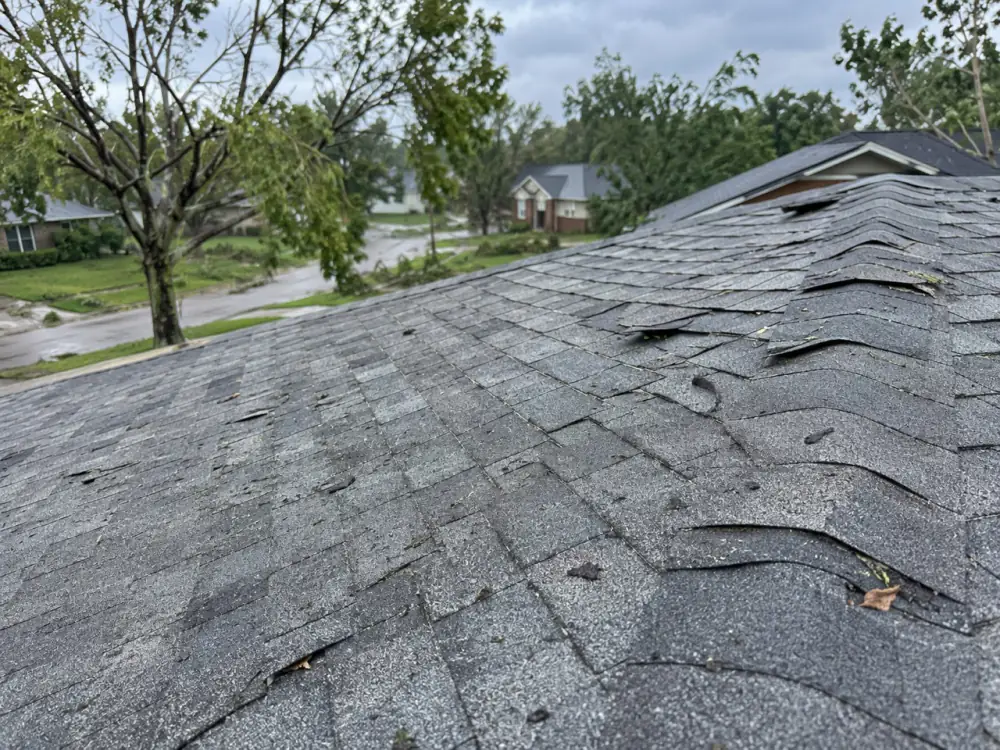
Storm damage roof repair in Rosthern is mostly a wind story. People tend to talk about hail after a storm, but on the open ground along Highway 11 between Saskatoon and Prince Albert, a lot of roof damage comes from straight-line wind. A roof can lose a handful of shingles in one of those and still look fine from the street, and the damage you can't see is the part that leaks later.
What happened in the RM of Rosthern on August 20, 2025
On the evening of August 20, 2025, a cluster of storms moved across central Saskatchewan, passing north of Saskatoon. Western University's Northern Tornadoes Project surveyed the damage from the ground and by drone over the next few days. It rated a downburst in the Gruenthal area, starting at 8:35 PM, as EF1, with an estimated top wind speed of 155 km/h. The team documented intermittent damage over an area about 22 km long and up to 7 km wide, with farm buildings, grain bins and trees hit in the Gruenthal, Neuanlage and Blumenthal areas.
Neuanlage is a hamlet in the Rural Municipality of Rosthern No. 403. Its Wikipedia entry records the downburst uprooting trees, taking down power lines, tearing chunks off roofs and wiping a single-car garage off its slab. The same storm cluster produced an EF0 tornado near Buffer Lake, which the survey team estimated at 105 km/h.
For a homeowner in Rosthern, note which one was stronger. The downburst was rated higher than the tornado that night, at 155 km/h against 105 km/h.
Downburst, plow wind, tornado: why the difference matters
A downburst happens when cold air from a thunderstorm drops out of the cloud and spreads out along the ground. On the prairies people often call it a plow wind. The wind blows in a straight line instead of rotating, and it covers a much wider area than a tornado does, which is why one storm can damage roofs across several farms and a whole hamlet at once.
That matters after the storm because straight-line wind hits one side of the house hardest. The windward slope, the ridge and the edges of the roof take most of it. When we inspect after a wind event, we start on the side the storm came from and work around.
What wind actually does to asphalt shingles
Each asphalt shingle is held down by nails and by a strip of sealant that bonds it to the shingle below. Strong wind gets under the bottom edge, breaks that seal and lifts the shingle. Sometimes it tears off completely. More often it folds back and drops into place again, leaving a crease across the shingle.
A creased shingle is the one to worry about. From the ground it looks like it is lying flat, but the seal is broken and the mat is cracked along the fold, so the next storm lifts it more easily and water can get under it. Wind also tears off ridge caps, peels back the shingles along the rakes and eaves, and bends the flashing around chimneys and roof vents.
What to check after a storm, from the ground
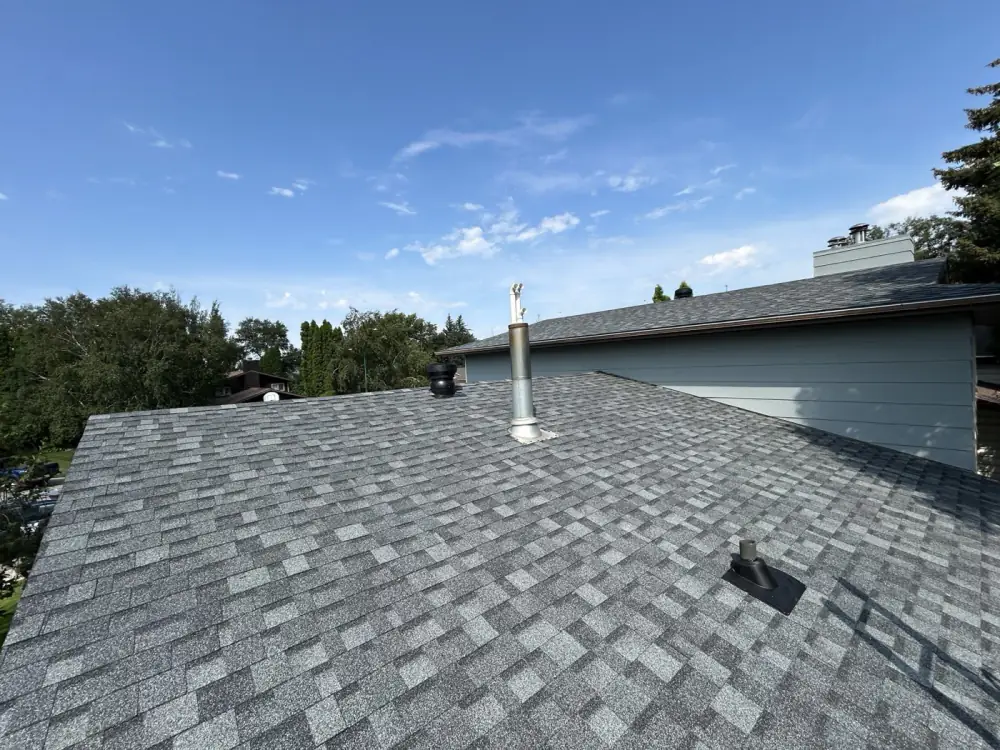
Stay off the roof, especially while it is wet. Most of what you need to know can be seen from the yard, ideally with a pair of binoculars:
- Missing shingles, or bare patches where you can see the underlayment or the wood deck.
- Shingles along the ridge, the rakes or the eaves that look lifted, wavy or out of line with their neighbours.
- Ridge caps that are missing or flipped up.
- Bent or loose flashing at the chimney, along walls and around vents.
- Pieces of shingle, or a lot of granules, in the yard, the eavestroughs or at the bottom of the downspouts.
- Dents in roof vents, eavestroughs or downspouts, which can point to hail as well as wind.
- Branches resting on the roof, or a tree limb that came down across the eaves.
Then go inside. Check the ceilings on the top floor, and if you can get into the attic safely, look for daylight through the roof boards or damp spots on the underside of the deck.
Photos to take before anything gets fixed
Take pictures before you clean up or cover anything. Shoot each side of the house from the yard, any shingles or debris on the ground, any dents, and any water stains inside. Note the date of the storm. In Saskatchewan, home insurance comes through SGI or a private insurer, and a clear record from right after the storm makes the conversation with your adjuster easier. Our guide to filing a hail damage insurance claim in Saskatchewan goes through that process in more detail.
Repair or replacement after wind damage
A few missing or creased shingles on a roof in good shape are usually a repair. The shingles get replaced, the edges and ridge get resealed, and any bent flashing gets fixed or replaced. When wind has broken the seal on shingles across a whole slope, or the roof was already near the end of its life, a repair just moves the problem to the next storm, and a full replacement is the better answer. Our post on whether to repair or replace a roof walks through how we make that call.
Whatever the answer, a roof that has lost shingles needs covering quickly if rain is coming, so the deck and insulation underneath stay dry until the repair is done.
Getting a storm inspection in Rosthern
Rosthern is part of our service area north of Saskatoon, and our storm damage roof repair service in Rosthern covers wind and hail. Every job starts with a free, no-obligation inspection. We get on the roof, mark the damage, document it with photos and video for your insurer, and give you a written quote with the scope spelled out. When it helps, we meet your adjuster on site. Every roof we install carries a 10-year workmanship warranty, and our storm and hail damage restoration page explains how we handle the full process.