
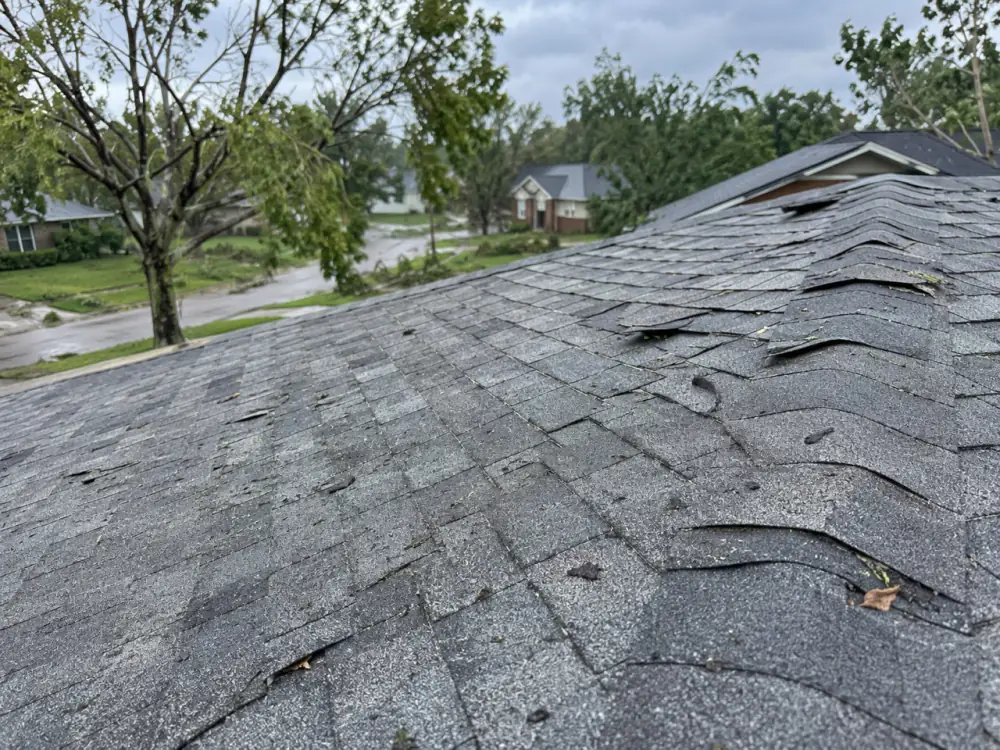
A prairie hailstorm can bruise a roof in a few minutes and leave almost nothing you can see from the driveway. Working through it in the right order protects your home now and your options later.
We are W Contracting Roofing, a Saskatoon roofing company, and the steps below are the order we work through after hail.
Here is what to do first, what to look for, and how to tell whether you are facing a repair, a full replacement, or an insurance claim.
Start with safety, then secure the house
Once the storm has passed, check on everyone in the house before anything else. Inside, look at the ceilings and around light fixtures for fresh water stains or active drips. If water is coming in, move furniture and electronics clear, put down a bucket or a bin, and photograph the spot for your SGI or private adjuster before you mop it up.
Stay off the roof, because wet shingles covered in hail are slick and a fall does far more damage than the storm did.
If there is a branch or debris up there, leave it for a crew with the right footing and harnesses, since your job right after a storm is to keep people safe and limit water damage inside.
What prairie hail actually does to a roof
Hail rarely punches a clean hole. On asphalt shingles it bruises the surface, knocking off the granules that protect the shingle and exposing the mat underneath, which is the bruising a HAAG Certified inspection looks for.
Those bruises shed more granules over the following weeks, and that is where the slow leaks start. On soft metal, hail leaves dents you can read like a fingerprint: vents, flashing, and eavestroughs all take marks.
The tricky part on the prairies is that this damage is often invisible from the ground for a while, then shows up as a stain on a bedroom ceiling in the fall. That gap between the storm and the symptom is why a careful check right after the hail is worth the effort.
How hail treats different roofs and older homes
Hail does not hit every Saskatoon roof the same way. The material and the age of the roof both change what the stones leave behind.
| Roof or part | What hail tends to leave |
|---|---|
| Asphalt shingles | Dark bruises where the granules came off, soft spots under the surface, and cracks in the mat on harder hits. |
| Metal roofing | Dents in the panels, ridge cap and trim. A lot of those dents are cosmetic, but a hit that cracks the coating or opens a seam or fastener will let water in. |
| Flat and rubber roofs | Bruises or small punctures in the membrane, plus cracked flashing at the edges and around vents. Water that sits on a flat roof will find them. |
| Vents, flashing and eavestroughs | Dents, crushed downspouts and cracked plastic vent caps. These are often the easiest proof that a storm was big enough to matter. |
Age matters as much as material. Shingles that have spent years drying out in prairie sun lose their flex, so a stone a newer roof shrugs off can crack an older one. The slopes facing into the storm usually take the worst of it, which is why our HAAG Certified inspections mark hits on every side and not only the one you see from the street.
Older homes add one more wrinkle, since a house that has been re-roofed before can hide problems under the top layer that nobody sees until the old shingles come off. If your roof has been done more than once, tell whoever inspects it.
Do a ground-level damage check, no ladder needed
Walk the yard and the outside of the house and look for the soft-metal clues first. Dents on eavestroughs, downspouts, roof vents and the metal caps around the chimney all point to hail heavy enough to bruise shingles, and they belong in the photos for your SGI or private adjuster. Check the window screens, the siding, the deck boards and the fins on the air conditioner for the same dinging.
Then look for granules, since a pile of dark, sand-like grit at the bottom of a downspout or washed into the eavestroughs is shingle surface that the hail knocked loose. If the soft metal around your house is dented and there are granules in the gutters, the roof almost certainly took hits too, even if the shingles look fine from below, and a HAAG Certified inspection can confirm it.
Write down what happened while it is fresh
Note the date and rough time of the storm while you remember it. Photograph the damage you can safely reach from the ground, and if there is still hail on the lawn, get a shot of it next to something for scale, like a coin or a ruler. Save any Environment Canada weather alert or local news about the storm.
This record gives a roofer a clear starting point, and if you end up filing a claim, it ties the damage to a specific storm on a specific day. That link between the damage and the event is one of the things an adjuster looks for.
What to photograph for your insurance file
Take the pictures before anything gets cleaned up or fixed, starting with a wide shot so an adjuster can tell where on the house you are, then moving in close. Your phone stamps the date and time on each one, so keep the originals.
Do all of this from the ground, zooming in on the roof from the yard or an upstairs window and leaving anything you cannot see safely for the inspection. We photograph and video every hit on the roof itself, and that record sits in the same file as yours.
Get a professional roof inspection
The only way to know what the hail actually did is to have someone on the roof who can tell storm bruising from ordinary wear and from cosmetic marks that do not affect how the roof performs. Our inspections at W Contracting are HAAG Certified, which is the standard insurers recognize for storm damage. We document everything with photos and video and walk you through what we found.
Because a W Contracting inspection is free, there is no downside to booking one after a real hailstorm. You either learn the roof is fine, or you get the documentation you need to move forward, and you find out before a small bruise becomes a winter leak.
Questions to ask a roofer after a Saskatoon hailstorm
After a big storm, out-of-town trucks and door-knockers show up in neighbourhoods across Saskatoon, Martensville and Warman. Some are local and some leave when storm season ends. These questions sort them out quickly, and we expect you to ask us the same ones.
- Where is your office? Our address is 410 Stensrud Rd #139 in Saskatoon, and we pick up at (306) 620-9709 Monday to Saturday, 8 to 6.
- Who does the inspection, and are they HAAG Certified?
- Will I see photos of every hit you mark?
- Is the scope and the price in writing before I sign?
- What warranty covers the workmanship? As a GAF Certified Plus contractor, we back our installs with a 10-year workmanship warranty through GAF.
- Will you meet my SGI or private adjuster on site if that helps?
- Where can I check your record? Ours is on our BBB profile, where we hold an A rating, and in our Google reviews.
Good answers do not mean you have to hire that company. They mean the inspection is worth taking seriously. If anyone pushes you to sign on the doorstep, say no and take a day to look them up on the BBB and in Google reviews.
Then decide: repair, replace, or file a claim
Isolated, minor damage on a roof with years left in it is often a straightforward roof repair. Widespread bruising on a roof near the end of its life usually points to a replacement, and that is frequently where an SGI or private insurance claim comes in. Our storm and hail damage restoration page covers how we handle the whole job.
Whatever the answer, do not rush it and do not sign anything before you know what is on the roof. If a claim is on the table, the next step is understanding the process, which we cover in how to file a hail damage insurance claim in Saskatchewan.
Permits, timing and the season in Saskatoon
In Saskatoon, putting the same kind of roofing back on does not need a building permit. The City of Saskatoon building permits page lists replacing or repairing roofing with exactly the same roofing material, above the decking, as work that does not need one. The same page lists repair after water damage, structural repairs and changing your siding material as work that does.
So if you plan to switch from shingles to metal, or a leak soaked the ceiling below, check with the City before the work starts. In Martensville, Warman, Dalmeny or another town, ask your own town office. We can go over which of these fits your job at the inspection.
When the hail falls also changes what comes next:
- Early summer storms leave time to inspect, settle the claim and replace the roof in warm weather, when new shingles seal down well.
- Late summer and fall storms put a clock on it. Bruised shingles that go into a Saskatoon winter take on meltwater, and every freeze and thaw works on them. If the full job cannot happen before the cold, ask about a repair that keeps water out until spring, and read our guide to getting your roof ready for winter.
- Damage found in winter or spring usually shows up as a ceiling stain or an ice dam. Your notes, your photos and any Environment Canada alert you saved from the storm day are what connect it back to the hail.
If water is already coming in, skip ahead to our emergency roof repair in Saskatoon page. For the whole storm job in the city, see storm damage roof repair in Saskatoon, and for dented or pulled-off gutters, our eavestrough, soffit and fascia work.
Hail damage questions from Saskatoon homeowners
How soon after a hail storm should I get my roof inspected?
Sooner is better. Hail bruising keeps shedding granules and can turn into a leak weeks after the storm, so getting eyes on the roof early protects both the roof and any future claim.
A W Contracting inspection is free, so there is no reason to wait. Call (306) 620-9709.
Can I tell if my roof has hail damage from the ground?
Should I file an insurance claim or just pay for the repair myself?
Does every hail storm damage a roof?
No. Whether a storm damages your roof depends on the size of the stones, the wind behind them, and the age and material of the roof.
A newer roof might shrug off small hail while an older one is bruised through. That is exactly why an inspection matters, so you are not replacing a roof that is fine or ignoring one that is not.