
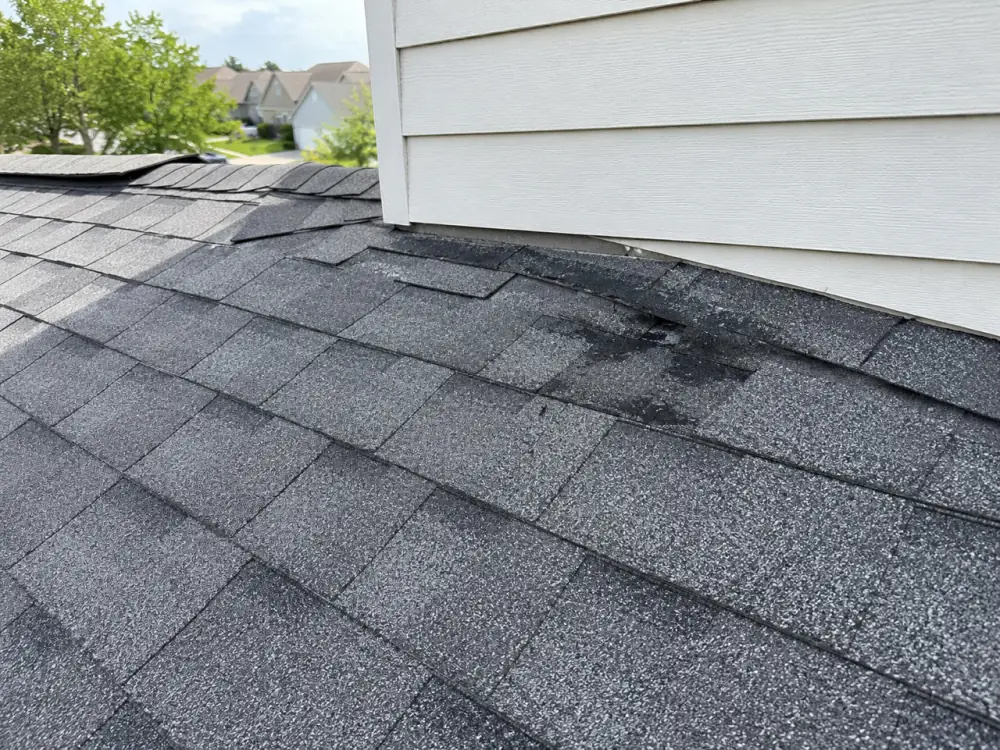
A roof leak never picks a good time. Whether it started in the middle of a storm or you just noticed a brown ring spreading across the ceiling, the first hour matters more than most people expect.
We are W Contracting Roofing, a Saskatoon roofing company, and urgent leaks go to the front of the schedule. If yours is live right now, start on our emergency roof repair page.
Here is what to do first, how to find where the water is really coming from, and how to tell whether you are dealing with a true emergency or something that can safely wait until morning.
First, get the water under control inside
Before you worry about the roof, deal with the water in the house: move furniture, rugs and anything with a cord away from the drip, and put a bucket or a bin under it.
If you can see the ceiling starting to bulge and hold water, that pooled water is heavy and about to come down on its own, and poking a small relief hole at the low point with a screwdriver, with a bucket underneath, lets it drain in a controlled way instead of bringing down a whole section of ceiling.
Take a few photos before you clean anything up, because a record of where the water came in and what it touched is worth having later, both for our HAAG Certified inspection and for any insurance claim.
What to photograph before anything gets cleaned up
Photos cost nothing and you only get one shot at them. Take them before the mop and the shop vac come out, and before anyone goes near the roof.
- The ceiling or wall where the water is showing. Get one wide shot so it is clear which room it is, then a close-up of the stain or drip.
- Everything the water reached, like flooring, furniture, or boxes in the basement if it ran down that far.
- The bucket every so often. It sounds silly, but it shows how much water came in.
- The outside of the house from the yard or the sidewalk: missing shingles, a bent vent cap, shingle pieces on the lawn, dents in the eavestroughs after hail.
- The attic, only if you can get up there safely.
Keep the originals on your phone instead of only sending copies around, because the original file holds the date and time. If you end up talking to your insurer, those timestamps help show when the damage happened.
Find where the water is actually getting in
Water almost never drips straight down from the hole in the roof. It runs along the underside of the sheathing, down a rafter, and shows up on the ceiling several feet from the real entry point. That is why chasing the stain rarely finds the leak, and our guide to what actually causes a roof to leak in Saskatoon covers where they usually start.
If you can get into the attic safely with a flashlight, look for the highest point that is wet and follow the water back toward the roof from there, since wet insulation, a dark streak on the wood, or a bright pinhole of daylight all point you upstream. If the attic is not safe to enter, leave it for the roofer, that is part of what an inspection is for.
Leaks that are not coming through the shingles
Plenty of ceiling drips start somewhere other than the roofing itself. It helps to rule these out, since the fix is different.
- Frost in the attic: in a cold snap, moisture from inside the house freezes on the underside of the roof boards, then melts and drips when the weather turns warm, usually in more than one spot, on a dry day.
- A bathroom fan that vents into the attic, or a fan duct that has come loose: look for water right around the fan.
- Plugged eavestroughs, full of leaves and seeds after a Saskatoon fall, or troughs pulled away from the fascia. Water spills over the back edge into the soffit or the wall, so the stain sits along an outside wall.
- Water under a window, which points at the window or the siding around it.
Eavestrough, soffit and siding problems are part of our regular work, and our eavestrough, soffit and fascia page covers that side. For reading the stain itself, see our guide to water stains on the ceiling.
Buy time from the ground, and stay off the roof
A wet roof is one of the most dangerous places you can be, and a fall does far more harm than the leak, so do not climb up to tarp it yourself. From the ground you can still help: clear a downspout that is backing up, and in a Saskatchewan winter pull snow away from the foundation so the water draining off has somewhere to go.
If the roof genuinely needs to be covered to stop the water, that is a job for a crew with harnesses and a tarp fastened so it does not lift in the wind. A tarp nailed on wrong adds new holes and can tear loose overnight, which is worse than the leak you started with.
When a leak is a real emergency, and when it can wait
Some leaks need someone out right away: water coming in near light fixtures or an electrical panel, a steady flow during a freeze, or a roof that has been torn open by a storm all count as emergencies, because the damage compounds fast.
A slow stain that appears in dry weather is urgent but not usually a middle-of-the-night call, so contain the water, photograph it, and book the first available inspection. Either way, do not ignore it, a small leak that freezes and thaws through a Saskatchewan winter turns into a much bigger repair.
How roof leaks show up in each Saskatoon season
The time of year tells you a lot about where to look. A leak in February and a leak in July usually have different causes here.
- Winter is ice dam season: snow melts higher up the roof, runs down and freezes again at the cold edge, and the water behind it backs up under the shingles. The leak shows up along an outside wall, often near the eaves, and attic frost belongs here too.
- Spring melt is when a lot of winter problems finally show, as snow packed into valleys and behind chimneys, like the brick chimneys on older Nutana and Caswell Hill homes, melts for days and soaks any gap in the flashing.
- Summer means storms: hail can crack or bruise shingles and a strong wind lifts tabs or tears them off, so a leak right after a storm usually has a cause you can spot from the ground.
- In fall, leaves and seeds fill the eavestroughs and heavy rain has nowhere to go. It is also the last good window to fix small things before snow sits on them through a Saskatchewan winter.
If an ice dam is behind your leak, our post on ice dams on Saskatoon roofs explains why they form. Environment Canada's Saskatoon forecast page lists any weather alerts in effect, and after a storm warning it is a good reminder to walk around the house and look up.
What to have ready when you call us
A few details on the first call help us sort out how urgent it is and what to bring. You probably won't have all of them, and that is fine.
- The address, and the best number to reach you.
- Where the water is showing up inside and roughly when it started.
- Whether it is still coming in right now. A slow drip and a steady pour are very different calls.
- What the weather did. If there was hail or a big wind, say so.
- Your photos, handy on your phone.
- How old the roof is, if you know, and whether anyone has worked on it lately.
- A claim number, if you have already called your insurer.
Anything you don't know, we find out on the inspection.
What we do on an emergency call
When we come out for an active leak, the first goal is simple: stop more water from getting in. That usually means a proper temporary cover or a targeted patch to weatherproof the roof until conditions are safe for a permanent fix. From there we do a HAAG Certified inspection, document everything with photos and video, and give you a straight answer on what caused the leak and what it will take to fix it for good.
We have come out at three in the morning to re-tarp a roof after a storm tore the first cover off. Getting the house sealed up comes first, the paperwork and the permanent repair follow once everyone is safe and dry.
After the leak is stopped: repair, or something bigger
Stopping the water is triage, not the whole job, and once the roof is dry the real question is whether this is an isolated roof repair or a sign the roof is near the end of its life and heading for a replacement. If the leak came out of a storm, there may also be an insurance claim in play, which our storm and hail damage restoration page covers.
Whatever the answer, you will have it in writing with photos and video from our HAAG Certified inspection, not a guess. If the damage traces back to a storm, our guide to what to do after a hail storm walks through the next steps.
Older homes and newer builds leak in different places
The age of the house changes where we look first. Older homes, like a lot of the houses in Nutana and Caswell Hill, tend to have a brick chimney, and sometimes more than one layer of shingles from past re-roofs. The flashing around that chimney and around old plumbing stacks is a common spot for water to get in.
Newer houses in Evergreen or Brighton, or in the newer parts of Warman and Martensville, usually have busier rooflines, with extra valleys and vents and often a wall that meets the roof partway up. Each of those needs flashing done right, and on a newer roof the leak is more often at one of those details than in the open shingles.
A roof that is only a few years old and already leaking points us at how it was installed, while on a roof near the end of its life a leak is more often plain wear, and our guide on whether to repair or replace your roof helps with that decision.
Questions to ask whoever comes out
An emergency visit moves fast and it is easy to forget to ask things. These are the questions we would want answered if it were our own house.
- What caused the leak, and can you show me in the photos?
- Is what you did today temporary, or is it the permanent fix?
- If it is temporary, what happens next and when?
- Did you check the attic and the roof deck, or only the shingles?
- Will I get the findings and the price in writing?
- Does this look like storm damage I should talk to my insurer about?
On our visits the answers come with photos and video, and every job starts with a free inspection and a written quote. We are GAF Certified Plus and HAAG Certified, with an A rating from the BBB. If a storm caused the damage, our page on roof insurance claims in Saskatoon explains how we work alongside your adjuster.
Emergency roof leak questions from Saskatoon homeowners
How fast can you get someone out for a roof leak?
Can a roof leak be fixed in a Saskatchewan winter?
Should I tarp the roof myself?
Will my insurance cover an emergency roof leak?
It depends on the cause: sudden damage from a storm is often covered, while a leak from long-term wear usually is not.
Document everything with photos and start with an inspection so you know what you are dealing with. Our guide to filing a hail damage claim in Saskatchewan explains how the process works.