
A leak rarely starts where the water shows up inside. Before you can fix one you have to know what let the water in, and on a Saskatoon roof it is usually one of a handful of things. Here is what we find behind most leaks, and how to tell which one is yours.
We are W Contracting Roofing, a Saskatoon roofing company, and tracing a leak back to its real source is the first thing a repair visit is meant to do.
Water is good at travelling. It gets in at a worn spot, runs along the decking or a rafter, and drips down somewhere else entirely, which is why the stain on your ceiling is a poor map to the actual hole. These are the causes we run into most on homes around Saskatoon, roughly in the order they turn up.
Shingles that are worn, cracked or gone
The shingles are the roof's first line of defence, and they wear out. Prairie sun bakes them all summer, wind lifts and creases them, and years of freeze-thaw leave them brittle enough to crack. Once a shingle is curled, split or blown off, the layer underneath is exposed and a leak becomes a matter of time.
On older homes in areas like Nutana and City Park, where a lot of the roofs have some age on them, worn shingles are the leading cause we see. A single hailstorm can do the same damage in an afternoon, which our storm and hail damage page covers.
Flashing that has failed around chimneys, skylights and walls
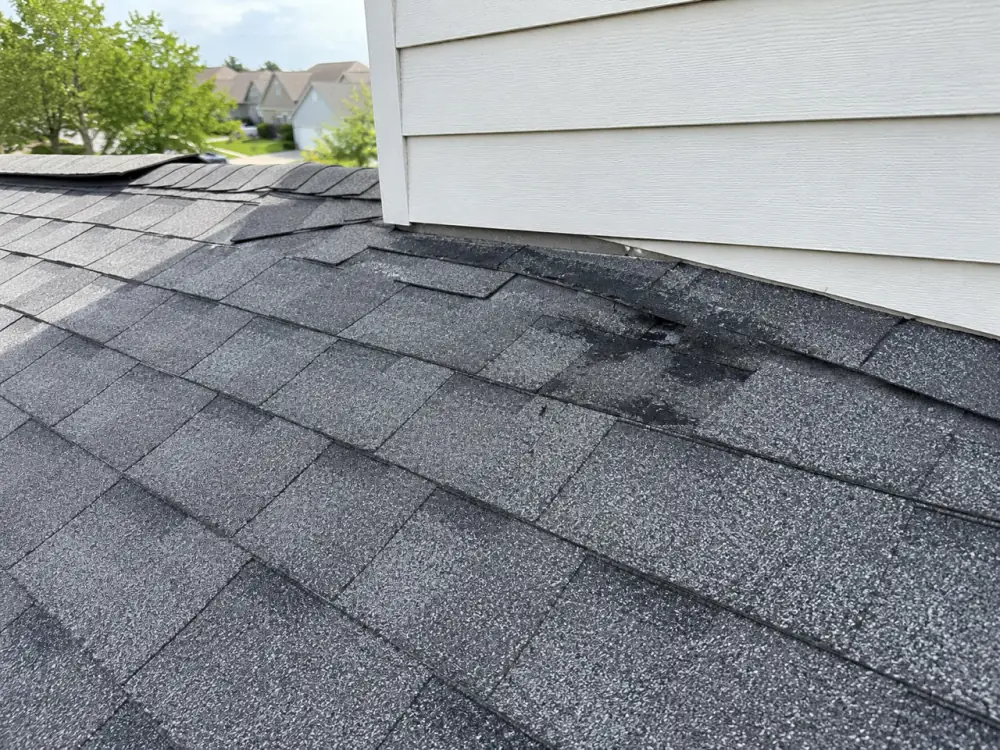
Flashing is the metal that seals the joints where a roof meets something else, a chimney, a skylight, a plumbing stack or a wall. It is one of the most common leak points on any roof, especially on older homes in Caswell Hill and Nutana, because those joints move and the sealant behind them dries out and pulls away over the years.
A roof can have perfectly good shingles and still leak steadily through a length of tired flashing. It is also one of the trickier repairs to get right, since the new work has to shed water the way the original was meant to.
The valleys where two slopes meet
Where two roof planes come together they form a valley, and a valley carries far more water than the open field of the roof, all of it funnelled into one narrow channel. When the valley flashing or the shingles woven through it wear out, that concentrated flow finds the weak spot fast. Valleys also catch and hold snow and ice through a Saskatchewan winter, which adds to the strain right when the roof is least able to take it.
Ice dams and plugged eavestroughs
In winter the leak often has nothing to do with a hole. Heat escaping into the attic melts the snow on the roof, the meltwater runs down to the cold overhang and refreezes into a ridge of ice, and the water backing up behind that ridge gets pushed up under the shingles. That is an ice dam, and it is a classic prairie-winter leak.
Eavestroughs packed with leaves or ice make it worse by giving the water nowhere to drain. Keeping the eavestroughs clear and the attic properly vented is what prevents it, which we walk through in the guide on stopping ice dams.
Cracked vent boots and other roof penetrations
Every pipe and vent that pokes through the roof is sealed with a rubber boot or a collar, and rubber does not last as long as the roof does. A Saskatchewan winter is hard on it.
Once a vent boot cracks, water runs straight down the pipe and into the ceiling below, often turning up as a stain in a bathroom or kitchen. It is a small part and an easy fix, but an easy one to miss if nobody thinks to check the penetrations.
When it is not the roof at all
Not every ceiling stain is a leak. In a cold Saskatoon winter, warm indoor air meeting a cold surface in the attic can condense and drip, and from below the result looks a lot like a roof leak, and a plumbing line in a wall or floor above can do the same thing.
Part of a proper inspection is ruling these out, because new shingles will not fix a condensation or plumbing problem. If you are looking at a stain and are not sure what it means, our guide on what a ceiling water stain is telling you goes through how to read it.
Match the spot inside to the likely cause
A stain won't point straight at the hole, but where it shows up still narrows the search a lot. These are the pairings we check first when a Saskatoon homeowner tells us where the water is coming through.
How roof leaks change with Saskatoon's seasons
The same roof can leak for different reasons at different times of year. When yours showed up is one of the most useful things you can tell a roofer.
How the age of the roof changes the answer
One leak on a young roof is usually a single, fixable fault, while a leak on a roof near the end of its life is often just the first, because the whole surface is wearing at once.
That is the point where a repair buys a season and a replacement may be the better value, a call we help homeowners weigh in the guide on repairing versus replacing a roof. Either way the fix starts with finding the actual source, which is what a roof repair visit and a free HAAG Certified inspection with photos are for.
Older homes and newer homes leak in different places
The age of the house changes where we start looking. Put a new roof on an old house and the chimney and additions are still there, along with whatever repairs came before.
In older neighbourhoods like Caswell Hill and Nutana, the chimney and the joints around dormers and additions come first. Old patch jobs sealed with roofing tar dry out and crack, and some older houses have a second layer of shingles over the first, which can hide soft decking underneath.
Newer houses in areas like Evergreen and Brighton have fewer of those joints but often more roof lines and valleys. On a newer home the leak is more often at a vent boot or a flashing detail, and attic trouble is common too, like a bath fan duct that came loose or insulation pushed up against the soffit vents.
If the house is only a few years old, dig out your paperwork first, since the builder or the manufacturer may still cover it.
What you can safely check yourself
Stay off the roof, especially when it's wet or icy. You can learn a lot from the ground and from the attic, and it gives whoever inspects it a head start.
- Walk around the house and look up, with binoculars if you have them. Note any missing, curled or lifted shingles, and flashing that's bent or pulling away.
- Check the ground under the downspouts, since a lot of shingle grit there, on a roof that isn't new, means prairie sun and freeze-thaw are wearing the shingles down.
- Watch the eavestroughs in a rain. Water spilling over the front edge, or thick icicles along the eaves in a Saskatchewan winter, point to a drainage or ice dam problem.
- Go into the attic with a flashlight during or just after a rain. Look for dark stains on the underside of the roof deck, water trails down the rafters and damp or flattened insulation.
- Turn the flashlight off and look for daylight around pipes and vents where they pass through the roof, since on newer homes in Evergreen and Brighton the leak is more often at a vent boot. If light gets through there, water can too.
- Trace the edge of the ceiling stain in pencil and write the date beside it, and if it spreads past the line after the next rain or thaw, the leak is active.
What to photograph and write down
Good records help us find a leak faster. If a storm caused it, your insurer will want to see them too, and our page on how a roof insurance claim works in Saskatoon covers what we document for the adjuster.
Keep the originals on your phone with the dates on them. If you plan to claim it, ask your insurer before you throw out any damaged materials.
Questions to ask the roofer who inspects it
A good inspection answers these without you having to push. If a contractor can't show you where the water is getting in, keep asking.
Our HAAG Certified inspections are free, and you get photos of what we find. Our Saskatoon roof repair page shows how a visit works. If water is coming in right now, go straight to emergency roof repair.
Roof leak questions from Saskatoon homeowners
Why is my roof leaking when it is not raining?
Can a roof leak without any missing shingles?
Where do roof leaks most often start?
Is a leaking roof an emergency?
It depends on what the water is doing. An active drip into a living space, a sagging ceiling, or water near a light or outlet needs attention right away.
A small, slow stain that is not spreading is not an emergency, but it is a reason to book a free HAAG Certified inspection before the next storm or thaw makes it one. Our emergency roof leak guide covers the call-now situations.